
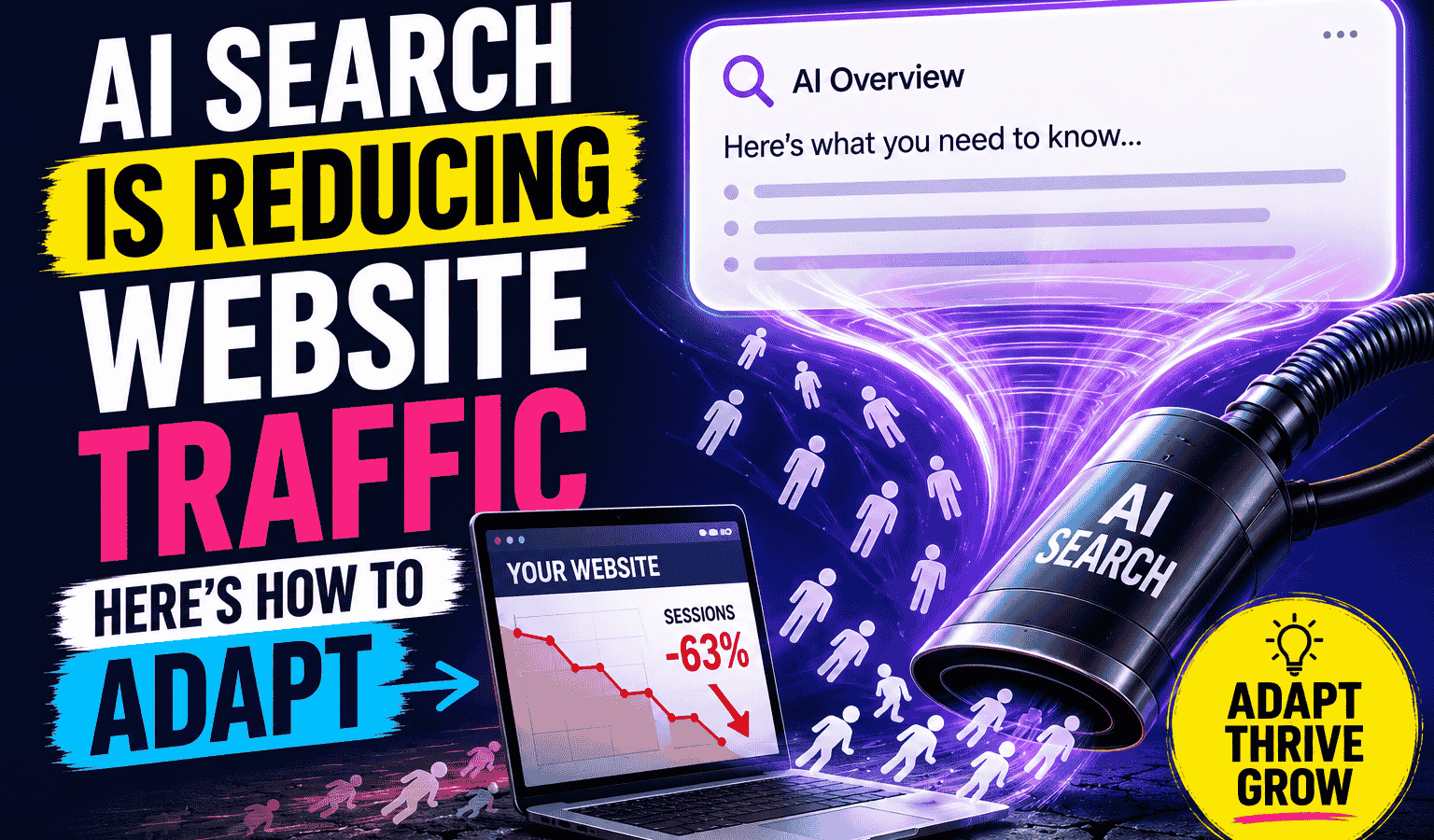
Google’s AI Overviews are changing how users interact with search.
Instead of clicking through to websites, users increasingly receive complete answers directly within search results.
The Data
Recent industry research shows:
- Nearly 60 percent of Google searches now end without a click
- Informational queries are most heavily impacted
- Studies indicate AI generated answers can reduce organic click through rates by 15 to 40 percent depending on query type
This is not a temporary fluctuation. It reflects a structural shift in user behaviour. Search engines are evolving into answer engines.
Why This Matters
For years, SEO focused on ranking highly and capturing inbound traffic.
That approach is becoming less reliable. Paid advertising is increasingly competitive and expensive. Organic visibility is harder to convert into traffic.
Businesses need a different approach.
From Passive SEO To Proactive Intelligence
Instead of asking:
“How do we rank for this keyword?”
We should be asking:
“Where are our customers, and what are they actually struggling with?”
This is where tools like OpenClaw become interesting.
OpenClaw is a locally hosted AI model that runs on your own machine. Unlike cloud tools, your data stays under your control, although careful consideration must be given to security and configuration.
Used strategically, a system like this could:
- Monitor selected online communities
- Extract recurring questions and themes
- Identify unmet needs
- Summarise insights into structured reports
- Draft targeted content for review
Rather than waiting for search engines to send traffic, you use AI to actively discover demand.
That is a fundamental mindset shift.
The Bigger Picture
Search driven traffic is becoming less predictable.
AI driven discovery and intelligence will increasingly shape competitive advantage.
SEO is not dead.
But passive SEO is under pressure.
The businesses that adapt now, combining AI insight with human strategy, will be better positioned for what comes next.
