A client said something to me recently that stayed with me:
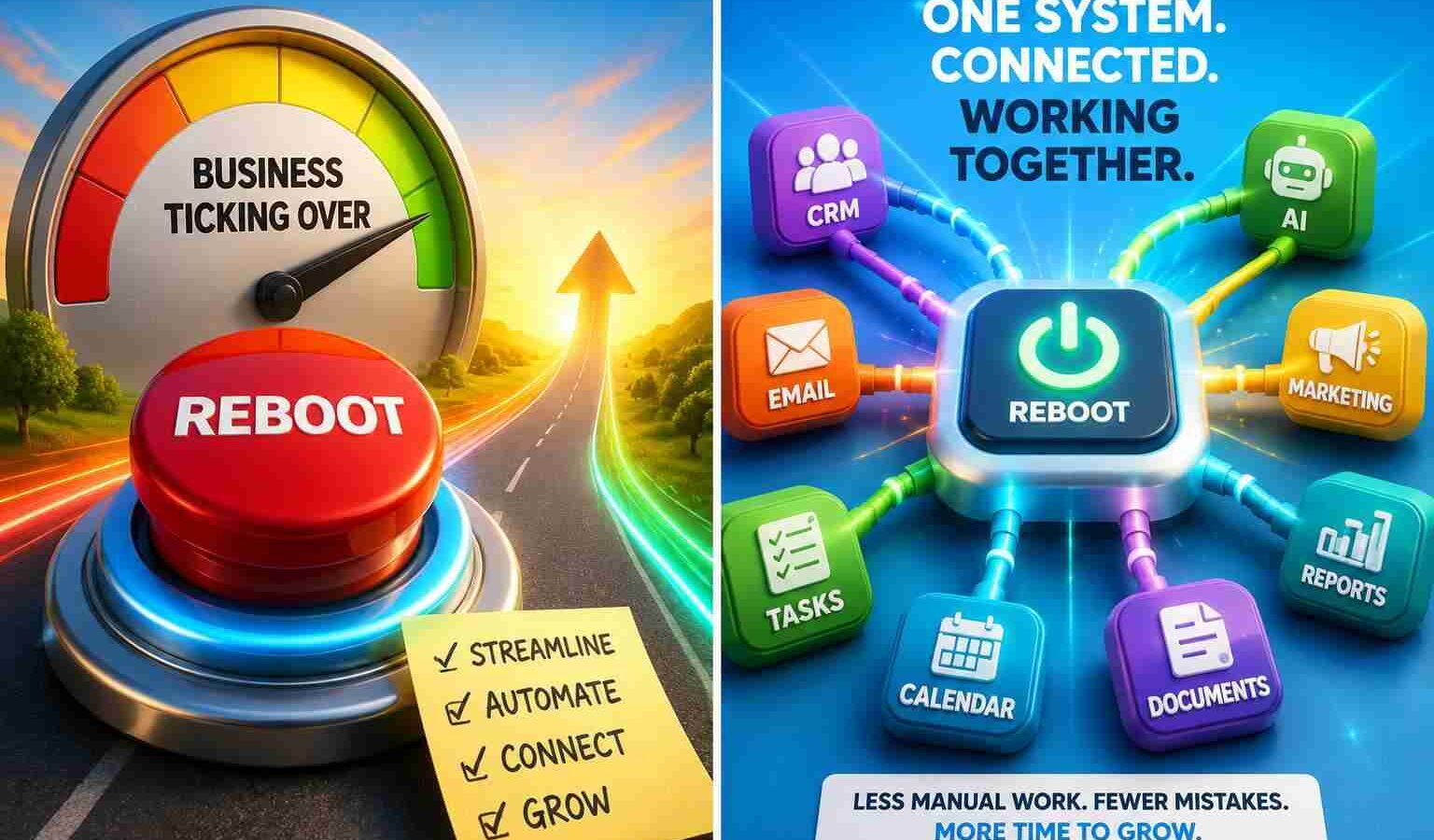
“Our business is ticking over, but it needs a reboot”
It is a good description of many established businesses.
The business is not failing. It still has customers, revenue, experience and a decent reputation.
But it has stopped moving forward.
Growth has slowed. Processes have become dated. The owner is involved in too many day-to-day tasks, and the business is relying on systems that were never designed to work together.
Everything still functions, but it takes more effort than it should.
What does a business that needs a reboot look like?
There is rarely one major problem.
Instead, there are dozens of smaller issues that have gradually become normal.
Customer information may be spread across emails, spreadsheets and several software platforms.
Staff may repeat the same administrative tasks every day.
Marketing may only happen when someone has spare time.
Potential customers may not be followed up consistently.
Reports may take hours to prepare.
Important knowledge may only exist in the head of the owner or a long serving employee.
AI may have been tested, but only through a few disconnected tools that have not changed how the business operates.
None of these problems necessarily stops the business from trading.
Together, however, they make the business slower, harder to manage and more dependent on individual people.
A reboot does not mean starting again
The word reboot can sound dramatic, but it does not need to mean replacing everything.
Most established businesses already have valuable assets:
Customers who trust them.
Staff who understand the industry.
Processes that work reasonably well.
Years of knowledge and experience.
A recognisable brand.
Useful customer and operational data.
The aim is not to throw these things away.
The aim is to remove the friction around them.
A business reboot starts by looking honestly at how the company currently works.
Where is time being wasted?
Which jobs are repeated manually?
Where do enquiries get lost?
Which systems do not communicate with each other?
What information is difficult to find?
Which tasks depend too heavily on the owner?
Where could automation or AI make a measurable difference?
Fix the process before adding more software
Businesses often respond to operational problems by buying another piece of software.
This can make the situation worse.
A new system is added, but the old spreadsheet remains.
A new CRM is purchased, but customer communication still happens through personal inboxes.
An AI tool is introduced, but nobody defines exactly what job it should perform.
The result is more logins, more data and more complexity.
A successful reboot begins with the process, not the technology.
First decide how the business should operate.
Then choose or build the systems needed to support that process.
Where AI can help
AI is useful when it is given a clear role within the business.
It might prepare a first draft of a customer reply.
It might summarise incoming emails and identify which ones require action.
It might monitor outstanding customer documents.
It might turn meeting notes into tasks.
It might research potential customers.
It might prepare reports using information already held by the business.
It might create content based on real customer questions.
It might help staff find information stored across documents and systems.
The important point is that AI should not be added simply because it is new.
It should solve an identifiable problem.
Reduce dependence on the owner
One of the clearest signs that a business needs a reboot is when too much depends on the owner.
The owner approves every decision.
The owner knows where every file is stored.
The owner remembers which customers need chasing.
The owner understands how all the different systems fit together.
The business may appear successful, but it cannot operate smoothly without constant intervention.
A reboot should capture that knowledge and turn it into clear processes, automated workflows and accessible information.
This does not remove the owner from the business.
It allows them to spend more time making decisions, developing services and speaking to customers, rather than managing repetitive administration.
Start with one area
A reboot does not have to happen across the entire company at once.
It is often better to choose one area that is causing obvious frustration.
That could be:
- Lead follow up.
- Customer onboarding.
- Email management.
- Quoting.
- Appointment booking.
- Document collection.
- Internal reporting.
- Content creation.
- Customer support.
Improve that process, measure the result, then move on to the next one.
This makes the changes manageable and provides evidence that the new approach works.
Your business may not need a new idea
Business owners are often encouraged to launch something new.
A new product.
A new service.
A new website.
A new marketing campaign.
Sometimes that is the right answer.
But sometimes the greatest opportunity is already inside the existing business.
The customers are there.
The knowledge is there.
The demand is there.
What is missing is a more effective way of operating.
Your business may not need to start again.
It may simply need a reboot.