
How I built a local news website with AI agents
A little while ago I started an experiment on a spare PC.
I wanted to see what would happen if I gave an AI agent a proper job, not a toy task, not a demo, and not one of those “write me ten social posts” experiments that looks clever for five minutes and then gets forgotten.
The job was simple to describe but awkward to do well:
Build a local news and information website for Cheltenham.
That site became Cheltenham Times.
This was not meant to be a polished media business on day one. It was an experiment. I wanted to see how far AI agents could go when they were given a real objective, access to tools, and enough room to make decisions. I also wanted to see where they would fail, because that is usually where the useful lessons are.
There were three rules from the start.
First, I wanted the setup to be as private and secure as possible. I did not want every small task being sent through a random collection of online tools with no thought about data, accounts or access.
Second, I wanted the running cost to stay low. If the point is to help small businesses, the numbers have to make sense. A system that costs hundreds or thousands a month before it produces anything useful is not very interesting to most business owners.
Third, it had to create something with actual value. Not just AI content for the sake of AI content. Something a real person might use.
The first version: let the agent build
I gave the agent a broad instruction: create a local news website for Cheltenham and start finding stories.
Within a day the site existed and the agent was creating posts. At the beginning it was producing around five to seven posts a day. Some were good. Some needed steering. Some were not worth publishing. That part matters.
AI is fast, but fast is not the same as right.
The early version could search for local stories, rewrite them into a suitable format, create featured images, add categories, handle basic SEO and publish into WordPress. It could also spot future story ideas and suggest what to do next.
That sounds impressive, and in many ways it was. But it also needed a lot of direction at the start.
I had to teach it what counted as Cheltenham, what did not, what tone was acceptable, which sources were useful, which images were misleading, and where a human would have used common sense. That learning phase is probably the part most people underestimate.
If you give an AI agent a job, you should expect a training period. Not training in the machine-learning sense, but training in the business sense. You correct it. You set rules. You tell it what good looks like. You build guardrails.
That is no different from taking on a junior member of staff, except the agent works very quickly and can make mistakes very quickly too.
How the site finds content
The site does not rely on one source.
The AI-assisted workflow checks local websites, public feeds, council updates, events pages, business news, community sources and social signals. It also looks at X for local leads, because a lot of useful local information appears there before it becomes a formal press release or article.
The important word there is “leads”.
I do not see AI as a magic truth machine. It is useful for scanning, sorting, summarising and suggesting. It can notice that a planning application has changed, that a local venue has announced something, that a council feed has a relevant update, or that people are talking about a local issue.
But it still needs rules.
For Cheltenham Times, the agent has to ask basic editorial questions:
- – Is this actually about Cheltenham?
- – Is it useful to a local reader?
- – Is the source reliable enough?
- – Is this a news post, a guide, an event, a club listing, or something better suited to a tool page?
- – Does the image match the story?
- – Is this too thin to publish as an article?
That last question is one of the most important. A local site can quickly become full of thin filler if nobody is careful. I did not want that. The point was not to create AI slop. The point was to create a useful local site, and to learn what AI agents can do when they are managed properly.
Why I added tools, not just articles
One of the early lessons was that news articles alone were not enough.
If you are building a local website, people need reasons to come back. A one-off article might get a spike. A useful tool can keep being useful.
The first big example was fuel prices.
Fuel prices were in the news, and they affect almost everyone locally. So I asked the agent to build a page that checked petrol stations around Cheltenham and showed which ones were cheapest for different fuel types. The page needed to stay up to date, so the agent refreshed it automatically.
I shared the page in a couple of local Facebook groups and traffic jumped to around 150 visitors a day, briefly. It did not stay there, but it proved the point. When the site solves a real local problem, people pay attention.
After that, we added more tools and useful sections.
Cheltenham property prices gave people a way to see how the local housing market was moving.
Rental property prices did the same for the rental market.
Planning applications made it easier to see what might be built nearby.
The school catchment map helped people think about schools when moving house or comparing areas.
These pages are different from ordinary blog posts. They are assets. They can be updated, improved, shared and linked to again and again.
That is the business lesson I keep coming back to.
AI agents are not just for writing content. They can create small digital assets that would previously have been too time-consuming or expensive to build for a local project.
Why clubs and events matter
The next step was to think less like a blog and more like a local information service.
Two sections stood out: clubs and events.
Local clubs are a good example of information that people genuinely want, but which is often scattered everywhere. Some clubs have websites. Some only use Facebook. Some have old pages that are out of date. Some are almost invisible unless you already know they exist.
A club section gives those groups a home and gives residents a way to discover them.
It is useful for the community, but it also makes sense for the site. Club listings can bring in searches from people looking for things like junior football, running clubs, art groups, choirs, volunteering, fitness, hobbies and support groups.
Events are similar.
A local events section is not just a list of dates. It can become a reason to visit the site each week. What is on this weekend? What is free? What is family friendly? What is happening near the town centre? What should I book before it sells out?
AI can help gather and organise that information, but again, the value is not the AI itself. The value is the useful local page that comes out of it.
For a business owner, this is the bit worth noticing. The agent was not just “making content”. It was helping shape the product.
It suggested sections. It found gaps. It noticed when a one-off article should really become a reusable page or tool. That is when the experiment started to feel less like automation and more like having a strange, very fast assistant working on the project every day.
The mistakes were part of the experiment
I do not want to pretend this all worked perfectly.
It did not.
Some featured images were wrong. One property story used an image that looked like a generic manor house when the actual subject was a town-centre shop. That is the sort of mistake a human would spot immediately, but an automated workflow can miss if the checks are not good enough.
Some stories needed better routing. A story about Stroud, for example, belongs on a Gloucestershire-wide site, not Cheltenham Times. That led to tighter rules about geography and relevance.
Some automations worked in theory but did not feed the right queue. Some social posts needed review before publishing. Some sources changed format, which meant the fetcher had to be fixed. Some article summaries were too short because the source feed only provided a cut-off description.
This is normal.
If you build with AI agents, you should expect mistakes. The question is not whether mistakes happen. They will. The question is whether the system gets better because of them.
Each mistake led to a new rule, test, check or workflow improvement.
Wrong image? Add image quality checks and safer fallback images.
Wrong geography? Add clearer Cheltenham versus Gloucestershire routing.
Thin source content? Add checks that catch cut-off articles before they become posts.
Social posting too risky? Move to review queues until the process is trusted.
That is how I think businesses should approach AI agents. Not as a finished magic employee, but as a system you improve over time.
What this means for business owners
The point of this case study is not that every business should build a local news website.
Most should not.
The point is that AI agents can now do useful work across a whole project, not just isolated tasks.
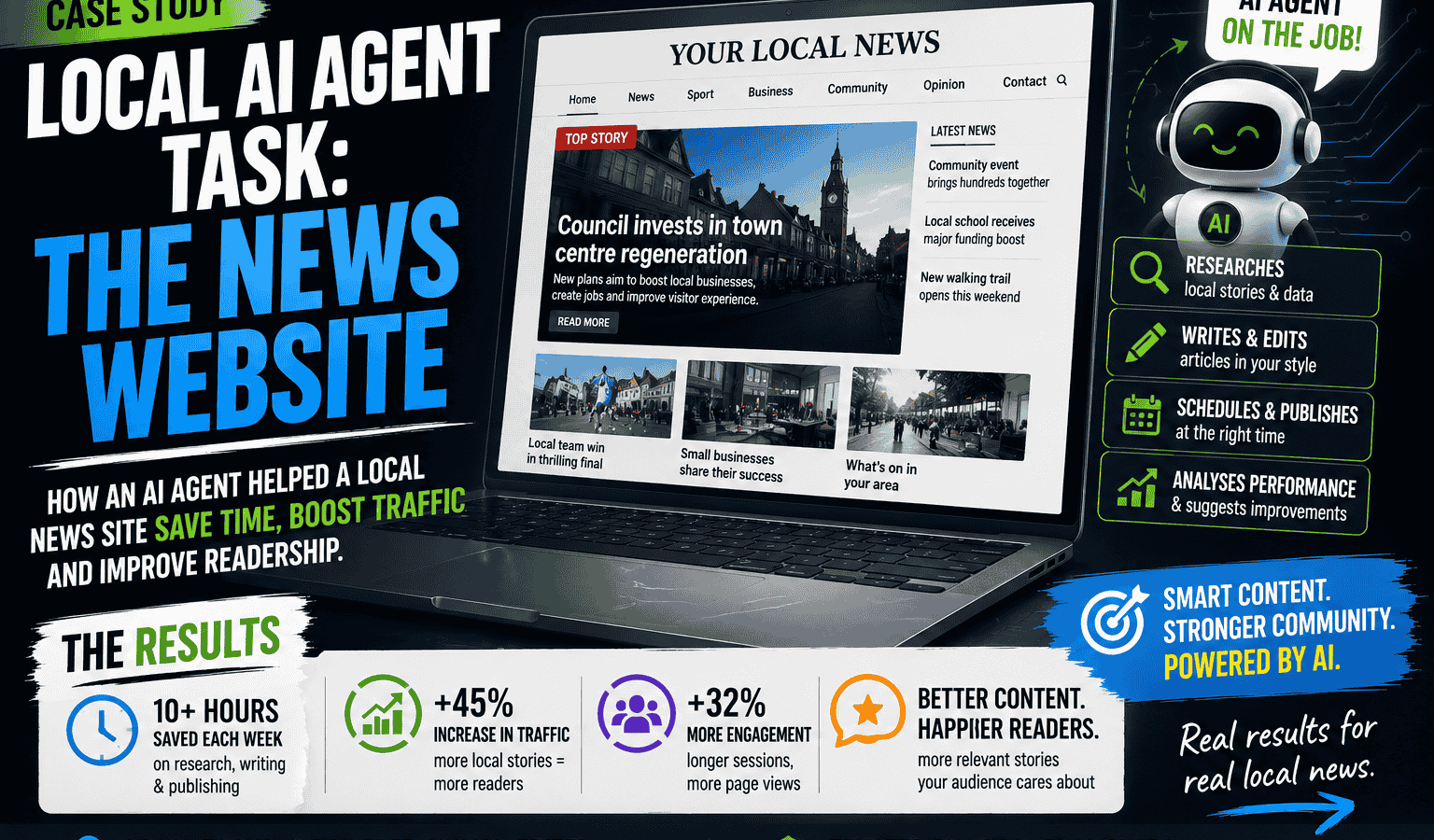
In this experiment, the agent helped research, write, categorise, publish, monitor, build tools, check sources, improve SEO, generate images, schedule updates and suggest new product sections.
That is a very different thing from asking ChatGPT to write a blog post.
For a business, the same pattern could apply to other problems:
- monitoring competitors or local opportunities
- maintaining a useful industry resource page
- turning messy public data into a customer-facing tool
- producing draft content from approved sources
- checking websites for changes
- creating lead lists from public information
- keeping product, price or availability pages updated
- drafting newsletters or social posts for review
The best use cases are not usually “replace a person”. They are jobs that are valuable but awkward, repetitive, research-heavy or previously too expensive to do properly.
That is where AI agents become interesting.
What I would do differently now
If I started again, I would put more guardrails in earlier.
I would define the geography rules sooner.
I would create image checks before the first batch of posts, not after the first bad image.
I would separate “draft”, “needs review” and “publish” workflows more clearly from the beginning.
I would also think earlier about the difference between content and tools. The tools have been some of the most interesting parts of the project because they create something people can use repeatedly.
But I would still do the experiment.
It has shown me that a small business can use AI agents to build things that would previously have needed a bigger team, a bigger budget, or simply more hours than most people have.
The trick is not to let the AI run wild. The trick is to give it a proper job, watch what happens, correct it, and keep improving the system.
Where the project is now
Cheltenham Times now has local news content, social lead monitoring, useful tools, sections for events and clubs, and automated workflows that keep parts of the site updated.
It is still an experiment. It still needs human judgement. It still makes me change the rules when something goes wrong.
But that is exactly why it has been useful.
It is not a polished fantasy about AI replacing everything. It is a practical example of what happens when you put AI agents to work on a real project and accept that the first version will not be perfect.
If you want to see the experiment, visit Cheltenham Times.
And if you run a business and you are wondering what a similar AI agent workflow could do for you, get in touch. The useful question is not “can AI write content?”
The better question is:
What useful job could an AI agent do for your business every day?